
Hotel Direct Sales Funnel: Attract, Convert and Retain
Build a hotel direct sales funnel that turns relevant traffic into direct bookings, improves the guest experience and gives travelers reasons to return.
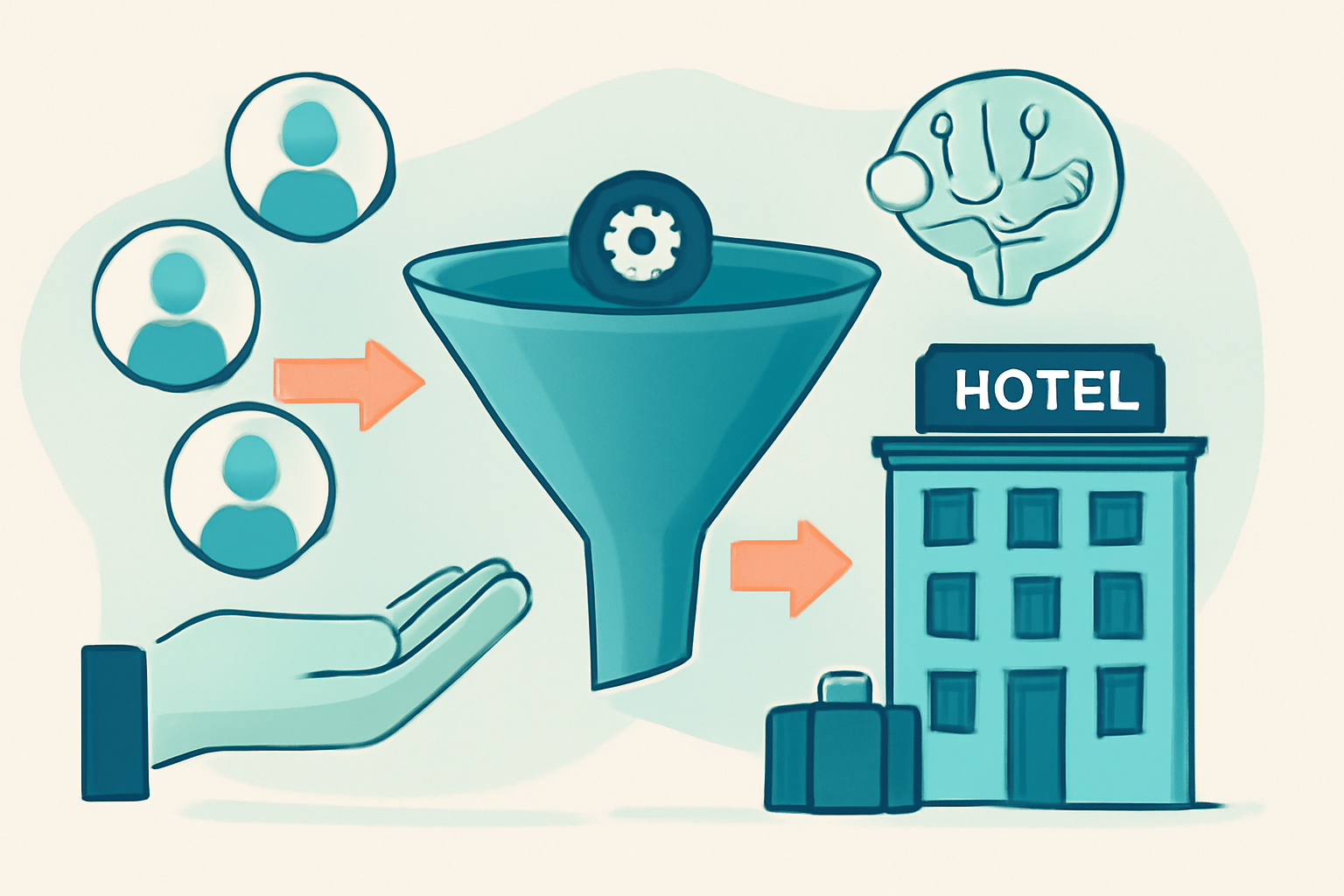
What a hotel direct sales funnel means
A hotel direct sales funnel is a way to organize the journey from a traveler discovering a property to booking directly and potentially returning. It gives an independent hotel three practical marketing goals: attract suitable demand, convert interest into direct hotel bookings and build a positive relationship after the stay. Looking at these stages separately is more useful than judging the whole strategy by visits or social media followers.
Attraction is about reaching travelers whose plans and expectations fit the property. Conversion means making it straightforward for interested visitors to book on the hotel’s website. The final stage is about delivering an experience worth remembering and giving guests a relevant reason to consider another stay. Travelers do not always progress in a straight line: they may compare several properties, return to a website later or book through another channel.
Before choosing tactics, decide whom the hotel wants to reach, what kind of stay it wants to sell and which business goal matters most. A rural property might emphasize weekend breaks, while an urban hotel could highlight a convenient base for cultural visits. These are different propositions, but both need to be clear and consistent from the first ad or search result through the website and the guest experience.
- Attract: generate interest among travelers who fit the hotel’s offer.
- Convert: make it easy to complete a direct booking on the hotel website.
- Encourage repeat stays: give guests a reason to return and maintain a respectful relationship.
Attract demand with relevant hotel digital marketing
Start by defining the demand the hotel wants: weekend breaks, family vacations, midweek stays or travelers interested in a local activity. Match the message to that intent and choose channels that can reach the intended audience. Organic search can answer travelers’ questions, while Google Ads and facebook ads for hotels can promote a specific offer. Paid campaigns are more coherent when the ad and its landing page make the same promise.
Make the hotel’s offer understandable within a few seconds. State the location, the type of stay, important amenities and what makes the property distinctive. Photos should represent the real guest experience, and copy should not promise anything the hotel cannot provide. When seasons or availability change, review ads and landing pages so the message remains relevant to the dates travelers are considering.
Measure the quality of visits, not just their volume. Relevant page views, inquiries, bookings and campaign cost can help show whether a channel is attracting people with a plausible interest in staying. A high number of clicks may have little value if visitors are not considering a booking. For more ideas on connecting promotion with direct sales, read these small hotel marketing strategies.
- Common mistakes include targeting too broadly, leaving outdated offers in ads and judging performance by impressions alone.
- Useful examples include promoting a seasonal break or a city stay with a clear offer and a closely related landing page.
Convert website visits into direct hotel bookings
A visit can turn into a booking when travelers find enough information to decide and can complete the reservation without unnecessary friction. Check that the website works well on mobile, room options and conditions are easy to understand, and the booking path is easy to find. Cancellation terms, included services and contact details can also answer questions that might otherwise stop a visitor from confirming.
Review the booking experience as a traveler who has never stayed at the hotel. Is it clear what each option includes? Can visitors see how to book? Does any page contradict what an ad or another part of the website says? If an important detail appears only in an advertisement or a phone conversation, make sure it is also available on the website. Clear information helps visitors compare with confidence and reduces uncertainty.
Track direct bookings, website conversion and booking abandonment alongside the visitor’s device and entry page. Compare similar periods and check for recent website or offer changes before drawing conclusions. For additional practical ideas, see this guide to increasing hotel direct bookings. More visits do not automatically mean better results: the important question is whether the traffic contributes to the bookings the hotel needs.
- Common mistakes include incomplete information, a hard-to-find booking path and differences between an ad’s promise and the website.
- Check the website on both mobile and desktop, and make sure booking terms are easy to locate before a traveler commits.
Encourage guests to return
Repeat business starts with a satisfying stay, but the relationship does not have to end at checkout. Relevant, considerate follow-up can help keep the hotel in a guest’s mind and make a future visit worth considering. A message should provide value rather than simply repeat a request to book. It might share a property update or an offer that relates to the kind of stay the hotel provides.
Give each communication a clear purpose instead of sending the same message to everyone. Consider consent, individual preferences and the rules that apply to personal data. Provide a straightforward way to stop receiving messages, and keep shared details current. Trust is part of the relationship: relevant content and a sensible communication frequency matter more than sending a large number of emails.
To assess this stage, review bookings from returning guests, responses to campaigns and communication unsubscribes. Interpret those signals in context: an email open does not guarantee a booking, and an unsubscribe can suggest that the topic or frequency is not a good fit. For a broader approach to repeat stays, see this guide to guest loyalty for independent hotels.
- A common mistake is treating repeat business as a one-off campaign rather than a relationship also shaped by the guest experience.
- Request permission where required, respect preferences and pay attention to which offers generate genuine interest.
Measure the funnel and avoid common mistakes
Choose a small set of useful measures for each stage and review them often enough to make decisions. For attraction, compare qualified visits and campaign cost. For conversion, consider direct bookings and website conversion. For repeat stays, review returning-guest bookings and responses to communication. The purpose is not to produce longer reports; it is to spot where an opportunity is being lost and decide which change is worth evaluating.
Read metrics together. If visits rise but bookings do not, review audience fit and the website experience before increasing campaign spend. If bookings are coming in but repeat stays are limited, consider the guest experience and whether post-stay communication is relevant. Avoid assigning an outcome to a single marketing activity without enough context: travelers may encounter several messages or channels before deciding.
A simple review routine can keep the work focused: set an objective, record a baseline, make one change at a time where practical and compare results over a reasonable period. Note factors that can affect demand, such as seasonality or local events. This makes it easier to distinguish a developing trend from a temporary fluctuation and gives the team useful learning without treating every change in a metric as a definite conclusion.
- Do not measure only clicks, opens or followers; connect activity signals to bookings and business goals.
- Avoid changing many elements at once when you need to understand what may have influenced a result.
- Do not compare periods with very different conditions without considering seasonality.
One platform to execute hotel marketing
For a small team, coordinating advertising, email, CRM and guest communication can take too much time. GuestBrain (guestbrain.io) is an AI hotel marketing platform for independent hotels that brings together tools to execute campaigns and help generate more direct bookings. Its modules include CRM, email marketing, Google Ads and Meta Ads, as well as options such as AI-powered WhatsApp, AI visibility and price parity monitoring.
GuestBrain is not a PMS, booking engine or channel manager, and it does not set room rates. It connects with the PMS and booking engine the hotel already uses. Its purpose is to give independent hotels access to the kind of marketing capabilities associated with large chains through one platform that also executes marketing activity. Learn more about AI hotel marketing for independent hotels.
Choose a solution based on the problems the hotel needs to address, the outcomes it wants to measure and the tasks currently taking up the team’s time. The right fit depends on the property’s priorities, not on the number of features in a product. To discuss what may suit your hotel, request a proposal. Any decision should start with the hotel’s goals and a realistic view of what its team needs most.
Frequently asked questions
More articles to go deeper into AI and hospitality
Keep reading
- AI for bookings / direct bookings for hotels
Repeat Direct Bookings from Past Guests Drive Profit
Maximize direct profit with repeat direct bookings from past guests. AI and CRM tools drive hotel retention and cut OTA reliance in 2026.
- Guest Experience and Loyalty
Hotel guest satisfaction surveys: complete guide
Complete guide to hotel guest satisfaction surveys: essential questions, actionable insights, and best practices to increase loyalty and direct bookings in
- hotel-marketing
Hotel Advertising ROAS: How Much Should Your Ads Return?
Understand hotel advertising ROAS, how to interpret it across channels, common mistakes, and the keys to maximizing your hotel’s return on every marketing